Sunday, 5 August 2018

Horsvaer Trip

I have just returned from another excellent trip to Horsvaer, in Nordland, Norway. For a second time Morten Helberg had invited me back to help him colour-ring the chicks of the Baltic Gulls that nest around the Horsvaer archipelago. We also visited Hortvaer and Fjordholmen.


Baltic Gulls Larus fuscus fuscus


Baltic Gull Larus fuscus fuscus


To reach Horsvaer, I flew from Stanstead to Oslo where I teamed up with Morten and then we flew north to Trondheim and on to Brønnøysund. A quick dash to the small shop for provisions was in order and then we boarded our boat Teist (Norwegian for Black Guillemot).


Teist

Despite it being overcast the sea was flat calm and so Runar our captain soon  ferried us across to Horsvaer. Picture the scene on arrival: three White-tailed Eagles roosting a couple of hundred metres away; Short-eared Owls quartering the island; Black Guillemots splashing about a few metres from our boat; a pair of Red-throated Divers off our stern and several Arctic Skuas harassing the Arctic Terns that were raising their chicks all around us.

We woke to dreary skies and as we eat our breakfast it began to rain. Luckily the rain soon stopped and we began our search for Baltic Gull chicks.


Presumed L. f. fuscus Chick

Most of the chicks hide in thick vegetation, but some like the one above make our task a little easier. Morten is the ringer and he worked tirelessly to ring just over 280 birds. Below you can see him taking measurements.


Morten Helberg Busy Ringing a Chick

Due to the vegetation it is not so easy to find the chicks on some islands.

The Baltic Gulls of Horsvaer are the subject of a paper written by Morten Helberg, Mars Muusse and myself which will be published in British Birds next month. The paper explains why we believe these birds should be treated as Baltic Gulls. Some controversy surrounds the birds due to concerns in Britain that the colonies are mixed - pale- and black-mantled birds. However, we have only seen two pale-mantled birds amongst hundreds of Black-mantled ones. 

Baltic Gulls Larus fuscus fuscus


Baltic Gull Larus fuscus fuscus


On the second day we put in a long shift, finishing at midnight. The scenery is top draw at Horsvaer - the photo below was took at midnight.


Roosting Baltic Gulls at Midnight

Whilst we spent most of our time searching for Baltic Gull chicks and ringing them, we also got to see some great birds. We saw seven Great Northern Divers including an adult; on one of the islands a juvenile Red-throated Diver was on a small pool and plenty of massive White-tailed Eagles kept their eyes on us.


It appears to have been a good breeding season on Horsvaer. Several pairs of Turnstone were behaving as though they had chicks.


The Arctic Skuas were also doing well.

In all we slept three nights on Teist, although I didn't sleep that well, as it got light really early. The two Norwegians didn't seem to suffer the same problem.

The sun appeared on our second full day and it got hotter and hotter, so much so that we found ourselves breaking into a sweat as we worked :-)


Hortvaer was a new site for me and it had been 10 years since Morten was there last. The gull colony was very healthy and the chicks were maturer than those at Horsvaer.


Hortvaer
The last part of our trip was spent at Fjorholmen. This island is close to the mainland and it supports a splendid Baltic Gull colony. One of the chicks we ringed there in 2017 has recently been seen in Sheffield. This one ticked the boxes for first-summer Baltic Gull.


Fjordholmen


PHOTOS OF THE 'HORSVAER GULLS'.

Sunday, 15 July 2018

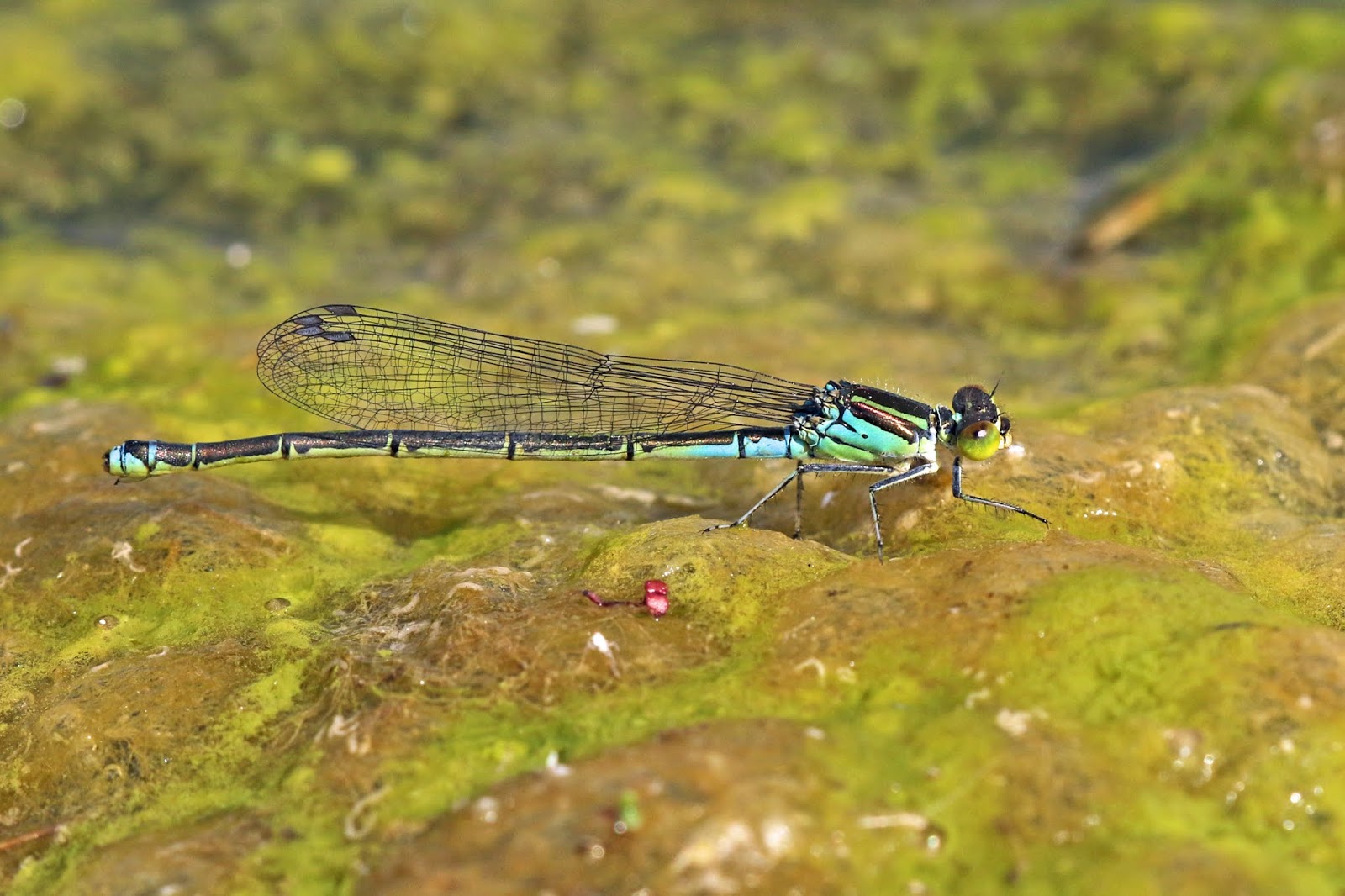
Small Red-eyed Damselflies

My only previous sighting of a Small Red-eyed Damselfly (SRED) in Leicestershire was of a male and female at Brascote Pits. However, that pit has been out of bounds for two years. With all this lovely sunshine surely this summer is going to be as good as any to find more?

Well last weekend Adey Baker and I found a small number at Croft Quarry Nature Trail pond. They were out on the small lillypads and so distant for photography.

SRED is a recent colonist to the UK with the first sighting dating back to 1999. The first Leicestershire record was in 2006 at Priory Water.

Yesterday I located at least thirty individuals on two newish ponds near Cotesbach. The ponds are quite shallow, so I went for a paddle and got very close to some of these tiny little beauties. Today I made more discoveries at Mere Lane Lake, Bittesby where there may have been over 100 and Shawell GP where I saw half a dozen and also a few Large Red-eyed Damselflies as well.

Male Small Red-eyed Damselfly

Female Small Red-eyed Damselfly
A few Emerald Damselflies were frequenting a small pond at Cotesbach Landfill site, which was a new record for the site.

Emerald Damselfly

Monday, 25 June 2018

Summertime

It's a good time for insects at the moment as far as the weather is concerned. I added a dragonfly to my life list on Saturday. I took a drive up to Kegworth in the north of Leicestershire where the River Soar meanders peacefully towards the Trent. In recent years a small number of Scarce Chasers have made their home along the county border north of Kegworth. I was fortunate to find five males and one of them posed well.

Scarce Chaser, River Soar, Kegworth

Also quite a few Banded Demoiselles fluttered around the river bank. Not always easy to photograph as they are flighty, but a few showed off for the camera.

Banded Demoiselle, River Soar, Kegworth


After this I headed off to Shawell and the gulls were not playing, so I had a look at the ponds off Shawell Lane where at least 20 Black-tailed Skimmers were bombing around.

Black-tailed Skimmer, Shawell Lane Ponds


After that Marbled Whites took over. Half a dozen were in the long grass at the back of Shawell Gravel Pits and at Croft Quarry on Sunday morning, Adey Baker and I found about 20 on the embankment near the picnic tables.

Marbled White

Sunday, 10 June 2018

Osprey at Brascote Pits

There has only been three previous accepted records of Osprey in the south-west Leicestershire area. Whilst at Brascote Pits today Adey Baker and I bumped into Colin Green. Whilst we were chatting we noticed the resident Oystercatchers were a bit agitated. We all noticed a Buzzard over the far pit and thought that was the cause of their angst and carried on talking. I then noticed a large raptor overhead and almost dismissed it as the Buzzard. Luckily I raised my bins and realised it was an Osprey and shouted Osprey! It circled around for a while with a Buzzard joining it.

Osprey, Brascote Pits, June 10th 2018


Brascote Pits is in bloom at present with lots of orchids. Southern Marsh, Common Spotted, Pyramidial and Bee Orchid plus lots of hybrid Common Spotted x Southern Marsh.

Southern Marsh Orchid


Bee Orchid

Southern Marsh x Common Spotted Orchids

Friday, 8 June 2018

German Ringed Gull Improving With Age

Last weekend I saw a colour-ringed gull from the German mixed colonies. I first saw this bird as a juvenile back in 2017 when it didn't look good for a pure Caspian Gull. However, last week it looked a little better.


X735, June 2018

X735, September 2017